Section 263A, the uniform capitalization rules (UNICAP for short), is one of the stickier areas of business tax.
The good news: since 2018, most small businesses are exempt. The bad news: businesses that grow past the threshold, or fall into one of its traps, can face one of the more involved calculations in the tax code.
What Section 263A does
Congress added Section 263A in 1986 so that businesses that produce property or buy property for resale would include the full cost of that property in inventory, rather than deducting some of those costs right away.
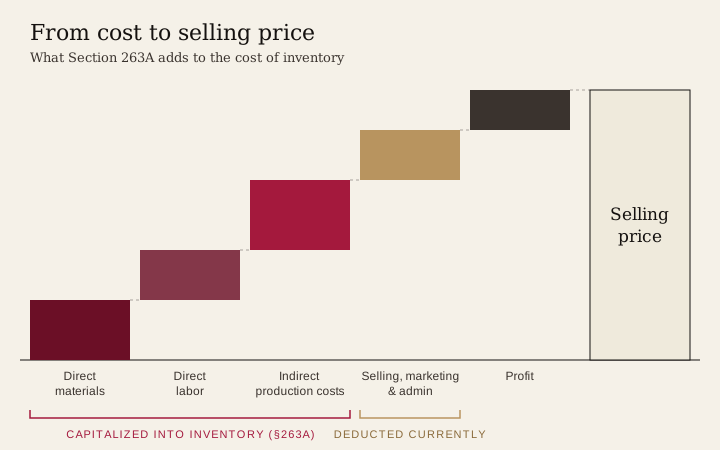
Think of a widget manufacturer. The raw materials and factory labor obviously go into the cost of each widget. Under UNICAP, so does a share of the indirect costs that make production possible: factory rent and utilities, depreciation on equipment, supervisor salaries, quality control, purchasing, warehousing, and part of the administrative costs that support production. Those costs become part of the cost of inventory on the balance sheet and are deducted as cost of goods sold when the inventory is sold, not when the cost is paid.
Who is exempt: the small business exception
Since the Tax Cuts and Jobs Act, a business is exempt from Section 263A if:
- its average annual gross receipts for the three prior tax years are at or below the inflation-adjusted threshold: $31 million for 2025 and $32 million for 2026, and
- it is not a tax shelter.
This exception applies to both producers and resellers, and to real and personal property. It replaced the old rule that exempted only resellers of personal property with receipts of $10 million or less.
Two traps to watch
- Related businesses are added together. If you own several companies under common control, their gross receipts are generally combined for this test.
- "Tax shelter" is broader than it sounds. For this purpose it can include an LLC, partnership or S corporation that allocates more than 35% of its losses to owners who don't actively participate in management. A small business with passive investors can lose the exception in a loss year.
Other exceptions
Even above the threshold, Section 263A does not apply to certain property and costs, including:
- property produced under a long-term contract (other than certain home construction contracts);
- property produced for personal, non-business use;
- certain creative costs of freelance writers, photographers and artists;
- research and experimental expenditures; and
- certain timber, farming and oil and gas costs.
Producers whose total indirect costs are $200,000 or less for the year are also exempt under the regulations.
What is (and isn't) capitalized
Capitalized: direct materials and direct labor; indirect production costs such as rent, utilities, repairs, depreciation, insurance, supervision, quality control, purchasing, and handling and storage; and the portion of general and administrative "service" costs that supports production or resale.
Never capitalized under 263A: marketing, advertising, selling and distribution costs (such as shipping to customers), research costs, and income taxes. These remain current deductions.
Making the calculation manageable
Larger businesses that are subject to UNICAP can usually use a simplified method, such as the simplified production method, the modified simplified production method or the simplified resale method, instead of tracing every cost. Changing methods generally requires filing Form 3115 (Application for Change in Accounting Method).
Simpler inventory options for small businesses
Businesses under the threshold have other options too. Under Section 471(c), they can generally:
- treat inventory as non-incidental materials and supplies (deducted when used or consumed), or
- follow the inventory method used in their financial statements or books and records.
Combined with the cash method of accounting, which is also available under the same threshold, this can significantly simplify a small company's tax accounting.
The bottom line
If your business is under the threshold, make sure you're not still doing UNICAP calculations you no longer need. If you're approaching it, or have passive investors and losses, plan ahead.